Increasing percentage blocks and coins representing corporate tax rates

Corporate Tax Rates in Singapore Explained: Effective vs Nominal Tax

Key Takeaways:

  • Singapore applies a flat corporate tax rate, but most companies pay less after exemptions and reliefs are considered.
  • The effective rate gives a more accurate view of a company’s real tax burden and helps guide financial decisions.
  • Start-ups and SMEs benefit from specific exemption schemes that encourage reinvestment and growth in their early years.
  • Understanding the full range of tax reliefs and incentives enables better budgeting, forecasting, and long-term financial planning.

Introduction

Singapore’s corporate tax system is widely regarded as competitive and transparent, offering a straightforward structure that supports business growth. Although the corporate tax rate in Singapore is officially set at 17%, most companies pay a lower amount once exemptions, reliefs, and incentives are factored in.

For SMEs, knowing the difference between nominal and effective tax rates is key to better financial planning. Understanding how these rates interact helps business owners manage cash flow efficiently, plan budgets accurately, and make informed decisions about reinvestment and expansion, while remaining compliant with the Inland Revenue Authority of Singapore (IRAS) requirements.

What Is the Nominal Corporate Tax Rate in Singapore?

The nominal corporate tax rate in Singapore is a flat rate of 17%. This rate applies to a company’s chargeable income before any exemptions or reliefs are applied and represents the statutory rate set by the IRAS.

In practice, however, this headline rate rarely reflects the actual tax paid. Many companies, especially small and medium-sized enterprises (SMEs), benefit from various deductions, exemptions, and government schemes that effectively reduce their overall tax burden.

How Does the Effective Tax Rate Differ from the Nominal Rate?

The effective tax rate reflects the actual amount of tax payable after exemptions, reliefs, and rebates are applied. In most cases, this figure is lower than the nominal 17% corporate tax rate in Singapore. The effective tax rate calculation takes into account partial exemptions, start-up reliefs, and other adjustments that reduce a company’s final tax liability.

For example, a business with S$300,000 in chargeable income may pay tax on only a portion of that amount after applying the relevant exemptions. As such, the effective rate provides a more accurate picture of a company’s real tax burden and plays a key role in financial forecasting and long-term planning.

How Do Start-Up and SME Exemptions Lower the Tax Burden?

New and smaller businesses can take advantage of the SME tax exemptions offered by Singapore to ease their financial burden in the early stages. Under the Start-Up Tax Exemption (SUTE) scheme, qualifying companies enjoy significant relief on their first S$200,000 of chargeable income during the first three years of assessment.

  • The first S$100,000 of chargeable income receives a 75% exemption.
  • The next S$100,000 enjoys a further 50% exemption.

This initiative encourages young companies to reinvest early profits into growth and stability. For established SMEs that no longer qualify for the start-up scheme, the Partial Tax Exemption (PTE) provides ongoing relief on the first S$200,000 of chargeable income each year.

Partnering with professionals who outsource accounting services can help ensure these exemptions are correctly applied, optimising your tax position and keeping your business compliant.

What Corporate Income Tax Reliefs Are Available to Businesses?

Beyond standard exemptions, Singapore offers a range of corporate income tax reliefs designed to ease business costs and support reinvestment. These may include capital allowances on fixed asset purchases, group relief to offset losses within related companies, and foreign tax credits for income earned overseas.

In some years, the government also introduces Corporate Income Tax Rebates to help businesses manage cash flow during challenging economic conditions. By strategically applying these reliefs and rebates, companies can lower their effective tax rate, strengthen financial resilience, and remain fully compliant with IRAS regulations.

Business professionals discussing financial data and calculating tax strategy

Why Understanding Both Rates Matters for Financial Planning

Understanding the difference between nominal and effective tax rates helps businesses plan more precisely and manage resources effectively. Accurate tax projections enable better cash flow management, timely preparation for quarterly payments, and sufficient provisions for IRAS obligations.

When supported by professional guidance, this understanding also reveals opportunities to optimise your overall tax position. Engaging experienced professionals who provide corporate tax services can streamline processes, minimise errors, and ensure filings remain compliant throughout the year.

By viewing the corporate tax rate in Singapore through both nominal and effective lenses, companies gain clearer insight into their real financial obligations, supporting stronger forecasting and long-term stability.

Conclusion: Make Singapore’s Corporate Tax System Work for You

Singapore’s competitive corporate tax rate continues to attract businesses seeking a stable, efficient operating environment. The real advantage, however, lies in understanding how exemptions, rebates, and reliefs influence your effective tax position and overall financial health.

With proper planning and accurate reporting, companies can maintain compliance, optimise cash flow, and take full advantage of Singapore’s pro-business tax framework.

As a trusted corporate services provider, Office M offers structured accounting and tax support tailored for SMEs. Our team helps businesses strengthen financial governance, simplify compliance, and plan with confidence throughout the year.

Contact us today to learn how our professional corporate and accounting services can help your business stay compliant, financially organised, and well-positioned for growth.

Business partners signing a legal compliance contract in Singapore

Preparing for Year-End: Compliance Checklist for Singapore Companies

Key Takeaways:

  • Conducting a thorough year-end review helps ensure that company records, officer changes, and financial statements are accurate and complete before filing deadlines.
  • Keeping statutory registers up to date throughout the year enhances transparency and supports effective corporate governance.
  • Finalising pending resolutions and documenting decisions prevents administrative delays and compliance issues in the next financial year.
  • Working closely with a qualified corporate secretary and accountant helps streamline filings, reduce errors, and maintain your company’s good standing with regulators.

Introduction

As the financial year comes to a close, many Singapore companies take the time to review their year-end compliance. It is more than just a routine exercise; it is a valuable opportunity to ensure all filings are up to date, records are accurate, and key corporate decisions are properly documented. These steps help your business remain in good standing with ACRA and prepare for a smooth start to the new financial year.

Here is a simple and practical year-end compliance checklist of what to review before closing your company’s books for the year.

Have You Filed All Changes to the Company Officers with ACRA?

A common issue that arises during the year-end compliance process is the failure to update ACRA regarding changes in company officers. If your business has appointed new directors, changed your company secretary, or updated shareholder details, these changes must be correctly lodged through BizFile+.

Leaving such updates incomplete can lead to discrepancies in public records, which may affect your company’s transparency and compliance status. Partnering with a company secretary service in Singapore ensures that all appointments and cessations are filed promptly and accurately, helping your business stay compliant and avoid unnecessary penalties.

Are Your Statutory Registers Up to Date?

Your company’s statutory registers serve as the official record of key details, including directors, shareholders, share capital, and charges. Over the course of the year, these records can become outdated if updates are not made after resolutions, share movements, or officer changes.

As part of your year-end compliance process, it is essential to carry out a statutory registers maintenance review. This ensures that every transaction and decision, from share transfers to new appointments, is accurately documented. Keeping your registers up to date not only supports good corporate governance but also makes future filings and audits much more efficient.

Have You Completed All Pending Resolutions?

Unresolved company matters can create compliance gaps and delay your year-end compliance process. Items such as dividend declarations, share allotments, or address changes should be reviewed and formally documented before the end of the financial year.

A corporate secretary’s year-end review provides the ideal opportunity to identify and finalise these outstanding matters. Completing them on time ensures that your company’s records remain accurate and transparent, providing directors, shareholders, and auditors with a clear picture of all corporate actions taken during the year.

Have You Prepared Your Financial Statements in Advance?

Even if your company qualifies for an audit exemption, financial statements are still needed for ACRA filing preparation. Preparing these documents early allows time to review performance, make adjustments, and address any accounting queries well before submission deadlines.

Engaging an outsourced accountant can make this process more efficient. With professional support, your financial data will be reconciled appropriately and presented in accordance with the Financial Reporting Standards (FRSs). Early preparation also helps your company secretary file the annual return promptly once the accounts are ready, keeping your year-end compliance on track.

Are You Coordinating Effectively with Your Corporate Secretary?

The final stage of year-end compliance involves reviewing the entire process with your appointed corporate secretary. Close coordination helps ensure that filings, resolutions, and statutory registers are consistent and complete, minimising the risk of last-minute issues.

Partnering with a trusted provider of corporate services in Singapore gives your business structured support for ongoing compliance. With professionals managing your statutory requirements accurately and on time, you can focus on running your operations with confidence and peace of mind.

Professional presenting a year-end financial report to company directors

Conclusion

Staying compliant at year-end is more than just completing administrative tasks. It is about maintaining a strong legal and operational foundation that supports your company’s long-term stability. Timely filings, accurate records, and well-documented resolutions demonstrate professionalism and reinforce your credibility with regulators, partners, and stakeholders.

For professional guidance with incorporation, annual filings, and ongoing year-end compliance, contact Office M today. Our team provides dependable support to keep your business compliant, organised, and ready for growth in the year ahead.

Accountant using a calculator for business GST registration compliance

GST Registration: When It’s Mandatory and When It’s Strategic

Key Takeaways:

  • Businesses must register for GST once their annual taxable turnover exceeds S$1 million or is expected to reach that level within a year.
  • Voluntary registration can be a practical option for companies that wish to claim input tax on purchases or improve cash flow efficiency.
  • Late registration can result in penalties and the need to pay tax on past sales, even if it was not collected from customers.
  • Registered companies must maintain proper records and submit accurate quarterly filings to remain compliant with IRAS regulations.

Introduction

For many businesses, GST registration in Singapore is not just a box to tick. It plays a vital role in pricing, reporting, and managing overall tax efficiency. The Goods and Services Tax (GST) applies to most goods and services in Singapore, including imports, and forms an integral part of your company’s compliance obligations.

Understanding when registration is mandatory and when it can be a strategic advantage helps your business stay compliant and financially prepared. Whether you manage an SME or a growing enterprise, knowing your taxable turnover threshold, registration options, and GST compliance requirements is key to effective and confident business management.

When Does GST Registration Become Mandatory in Singapore?

GST registration becomes mandatory when your company’s taxable turnover exceeds S$1 million over the past 12 months or is expected to cross that amount in the next 12 months. This threshold is set and closely monitored by the Inland Revenue Authority of Singapore (IRAS).

If your business meets or is projected to meet this limit, you must complete registration within 30 days. Missing this deadline can result in penalties and backdated tax liabilities. Working with a reliable corporate services provider in Singapore ensures your financial records are monitored consistently, helping you spot registration triggers early and maintain full compliance with IRAS requirements.

Can Businesses Register for GST Voluntarily?

Companies that fall below the taxable turnover threshold can voluntarily apply for GST registration. This option is often beneficial for SMEs that work mainly with GST-registered suppliers or plan to make significant investments in equipment, technology, or other business assets.

Voluntary registration allows businesses to claim input tax credits on eligible purchases, improving cash flow and cost management. With professional support from SME accounting services, your application, eligibility review, and documentation can be handled accurately and efficiently, minimising the risk of delays or IRAS rejection.

What Happens If You Register Late for GST?

Missing the GST registration deadline can lead to financial and administrative consequences. IRAS may issue fines, and your business may be required to pay GST on previously collected revenue, even if the tax was not collected from customers at the time.

Such penalties can affect cash flow and complicate accounting. Engaging professionals who provide corporate tax services in Singapore helps you track essential deadlines, manage documentation, and ensure that all registrations and filings are submitted accurately and on time.

What Are the Ongoing Obligations After Registration?

After registration, businesses are required to meet ongoing GST compliance requirements, which include submitting GST returns every quarter and maintaining complete, accurate accounting records. These quarterly GST filing obligations involve detailed tracking of all taxable sales and purchases, supported by clear documentation and consistent record-keeping practices.

Having professional oversight helps simplify these recurring responsibilities. Engaging a qualified corporate advisory firm in Singapore ensures that your filings are timely, accurate, and compliant with IRAS standards, reducing administrative workload and helping your company maintain a solid compliance record.

TAX blocks on coins illustrating strategic GST tax planning.

Which Businesses Can Benefit from Strategic Registration?

Certain businesses may find that registering early for GST brings clear financial advantages. Exporters, B2B service providers, and companies that make significant capital investments can often benefit from early registration, as it allows them to recover input tax on major purchases or overseas transactions.

For example, a company investing in new machinery, technology systems, or infrastructure upgrades can claim GST paid on these expenses, helping to strengthen cash flow and support reinvestment. With professional guidance, businesses can evaluate whether early registration fits into their broader financial and growth strategy.

Conclusion: Making GST Work for Your Business

Knowing when GST registration in Singapore is mandatory and when it can be a strategic choice helps SMEs make informed, timely decisions. Staying compliant not only avoids penalties but also strengthens financial management and builds business credibility.

If you are unsure how GST impacts your operations, Office M is here to help. As a professional corporate solutions firm in Singapore, we provide comprehensive support covering GST registration, quarterly filing, and ongoing corporate tax advisory. Our structured services are designed to keep your business compliant and financially organised, allowing you to focus on growth with confidence.

Contact us today to find out how our accounting and tax solutions can help your company maintain compliance and enhance financial governance.

Business owner filing tax-deductible expenses using a calculator.

Tax-Deductible Business Expenses in Singapore: What Can Your Company Claim?

Key Takeaways:

  • Only expenses incurred wholly and exclusively for income generation can be claimed under the IRAS guidelines
  • Daily operational costs, marketing activities, and employee training are generally claimable when properly documented.
  • Big-ticket purchases, such as equipment or furniture, are not directly deductible but can be written off over time through depreciation.
  • Detailed record-keeping and professional guidance help ensure smoother submissions and reduce the risk of non-compliance during filing.

Getting Started with Tax-Deductible Expenses

Understanding tax-deductible expenses is a key part of managing your company’s finances in Singapore. For many SMEs, knowing which costs can be claimed makes a real difference to cash flow and long-term financial planning.

According to IRAS, only expenses incurred wholly and exclusively for producing income are deductible. In simple terms, they must directly support your business operations. By identifying the right categories early, you can stay compliant, make informed spending decisions, and prepare more confidently for annual filing.

Here’s a closer look at some of the most common claimable business expenses and how they can help your company manage taxes more efficiently.

Which Operating Expenses Are Deductible for Businesses in Singapore?

Most everyday operating costs that keep your business running are considered tax-deductible expenses. These include rent for your office or retail space, utilities, staff salaries, and office supplies. Fees paid to contract accountants, legal advisors, or other professional consultants also qualify when the services are directly related to generating income.

Accurate record-keeping is crucial. Keeping receipts, invoices, and service agreements organised supports your claims during tax season. Well-maintained documentation not only ensures smoother reviews by IRAS but also helps prevent unnecessary delays in your corporate tax filing process.

Can Marketing and Advertising Costs Be Claimed as Tax Deductions?

Marketing and advertising costs are generally deductible when they are incurred to generate revenue. This covers expenses such as digital campaigns, printed brochures, trade shows, and social media promotions aimed at growing your business.

For instance, if your company launches an online advertising campaign to promote a new service, those costs can be claimed as tax-deductible expenses. However, activities like sponsorships or events that are not directly linked to income generation may fall outside IRAS’ allowable scope.

Are Staff Welfare and Training Costs Allowable Under IRAS Rules?

Employee-related expenses can qualify for IRAS allowable deductions if they serve a clear business purpose. Training fees, professional development courses, and skill enhancement programmes are typically deductible when they improve your employees’ ability to perform their roles and contribute to company growth.

Welfare costs such as team meals, appreciation tokens, or company retreats may also be claimable if they help build morale and productivity within reasonable limits. It is important to document these expenses carefully and ensure they are proportionate to your business size and operations.

Are Capital Expenditures Tax-Deductible?

Capital expenditures, such as purchasing equipment, vehicles, or office furniture, are not directly deductible from your company’s income. However, businesses can claim capital allowances, which allow them to recover these costs gradually over time.

These allowances account for depreciation, spreading the asset’s value across several years. For example, if your company invests in new computers or machinery to support daily operations, you can claim part of the cost each year as part of your tax computation.

Working with professionals who provide corporate tax filing services helps ensure that your claims are calculated accurately and submitted in accordance with IRAS guidelines and prescribed timeframes.

Professional driving car for business-related tax deduction claims.

Can Entertainment, Travel, and Motor Expenses Be Claimed for Tax Purposes?

Entertainment, travel, and motor-related expenses are deductible only when they are clearly tied to business activities. IRAS reviews these claims closely to ensure they are genuinely incurred for income generation. Deductions may apply to client entertainment, business meals, or travel for meetings and corporate events, provided there is a clear and documented business purpose.

For motor expenses, only vehicles used for commercial operations, such as goods delivery or transport services, are usually claimable. Private passenger cars (S-plated vehicles) are generally not deductible unless they are used for approved commercial purposes under IRAS regulations. To support your claims, keep detailed records showing the nature of each expense, who was involved, and how it relates to your business.

Engaging outsourced accountants or professional advisors can help review these claims and ensure your documentation aligns with compliance standards, particularly for expenses with both personal and business use.

Conclusion: Improve Compliance and Cash Flow Through Smarter Tax Planning

Knowing what qualifies as tax-deductible expenses allows your company to claim and manage cash flow with greater confidence and accuracy. By distinguishing between operating, marketing, staff-related, and capital costs, SMEs can make informed financial decisions that balance compliance with business growth.

Working with professionals who provide accounting services in Singapore or assist with outsourced accounting functions makes tax filing far more efficient. Expert guidance helps ensure accurate deductions, timely submissions, and stronger financial governance overall.

If your business requires dependable corporate support or ongoing accounting services, Office M offers structured, transparent solutions to keep your company compliant and financially sound.

Contact Office M today to find out how professional tax planning can help your business operate more efficiently and plan ahead with assurance.

Office M accountant calculating SME tax planning

Tax Planning for SMEs in Singapore: Steps to Take Before Financial Year-End

Key Takeaways:

  • Reviewing financial records before year-end helps ensure all income and expenses are accurately captured, reducing the risk of errors during filing.
  • Strategic timing of purchases and payments can optimise deductions and improve a company’s overall financial position.
  • Taking advantage of government schemes, allowances, and exemptions allows businesses to manage their obligations more efficiently.
  • Early estimation of tax liability and proper documentation of staff-related expenses promote smoother compliance and stronger financial control.

Introduction

As the financial year comes to an end, many SMEs in Singapore begin reviewing their accounts and obligations through strategic tax planning. This process plays a vital role in improving cash flow, managing compliance, and ensuring that no opportunities for relief are overlooked. By preparing early, businesses can close their books with confidence, avoid last-minute errors, and position themselves for a stronger start to the new financial year.

How Can SMEs Ensure All Revenue and Expenses Are Accurately Recorded?

Accurate record-keeping is the cornerstone of effective tax planning. Before closing the financial year, SMEs should review all sources of income and deductible business expenses to confirm that all transactions have been properly recorded. This includes reconciling invoices, verifying supplier payments, and ensuring employee or operational expense claims are up to date.

Comprehensive records not only support smooth audits but also strengthen your company’s ability to claim eligible corporate tax deductions and maintain compliance. Working with experienced accountants can help identify deductible items that are often overlooked, such as business software subscriptions, equipment depreciation, and utilities used in day-to-day operations.

Why Does the Timing of Purchases and Payments Matter for Tax Efficiency?

The timing of your company’s expenses can significantly influence your overall tax position. By bringing forward essential purchases or settling outstanding liabilities before the financial year ends, SMEs may be able to reduce taxable income and improve cash flow management.

This approach works particularly well for businesses planning to invest in new equipment, technology upgrades, or staff training. Making these payments before year-end allows companies to maximise available deductions and maintain operational efficiency going into the next financial period.

What Tax Reliefs and Incentives Are Available for SMEs in Singapore?

Singapore provides a wide range of tax reliefs and incentives to support SME growth and innovation. These may include capital allowances for qualifying assets, start-up tax exemptions, Enterprise Innovation Scheme (EIS) benefits, and other productivity support measures where applicable.

To benefit fully from these opportunities, it is vital to understand how each scheme applies to your company’s structure and operations. Working with a qualified tax consultant ensures that reliefs are applied accurately and documented properly. Expert guidance also helps you avoid compliance errors and make the most of available savings under IRAS regulations.

How Should Director Fees, Bonuses, and Staff Benefits Be Declared?

If your company plans to claim director fees, bonuses, or staff benefits as deductible expenses, these must be properly approved and documented before the financial year ends. This ensures the amounts are recognised within the correct accounting period and accurately reported to IRAS.

Many SMEs underestimate how timing affects eligibility for deduction. Maintaining clear records and board approval minutes not only simplifies submission but also reflects sound governance and financial discipline, both of which contribute to responsible tax planning.

Why Work With an Accountant to Estimate Tax Liability and Prepare ECI?

Estimating your company’s tax liability in advance provides a clear picture of upcoming obligations and helps manage cash flow more effectively. In Singapore, the Estimated Chargeable Income (ECI) must be filed with IRAS within 3 months of the financial year-end, even if your company estimates zero taxable income (unless exempted). Engaging professional support for ECI filing preparation ensures your submission is accurate, timely, and fully compliant.

Partnering with experienced professionals offering corporate tax services provides greater clarity and confidence throughout the process. They can help forecast tax liabilities, prepare the required documentation, and identify eligible deductions, allowing you to focus on growing your business while staying compliant with regulatory deadlines.

Discussing financial reports for year-end tax strategy

Conclusion: Strengthen Your SME’s Financial Position With Proactive Tax Planning

Effective tax planning goes beyond meeting statutory requirements. It provides an opportunity to enhance financial stability, manage resources wisely, and prepare your company for the year ahead. By carefully reviewing records, planning the timing of key expenses, and applying available reliefs, SMEs can maintain healthy cash flow and stronger compliance.

With professional support from Office M, your business can streamline accounting, reporting, and compliance tasks with confidence. Our experienced team offers practical, reliable guidance to help SMEs operate efficiently and stay fully aligned with regulatory standards.

Contact us today to learn how tailored tax solutions can support your company’s growth and long-term financial goals.

A woman reviewing tax documents and a laptop for IRAS filing.

How to Avoid IRAS Late Filing Penalties

Key Takeaways:

  • Timely filing protects your business from penalties. Understanding submission timelines for ECI, Form C-S or C, and GST returns helps prevent unnecessary fines and administrative stress.
  • Good record-keeping supports accurate submissions. Maintaining organised financial documents ensures that filings are completed smoothly and without delays.
  • Ignoring official notices can lead to greater consequences. Failing to respond to IRAS correspondence may result in estimated assessments or enforcement actions.
  • Professional support simplifies compliance. Outsourcing accounting and tax management allows businesses to meet obligations efficiently and focus on growth.

Introduction

For businesses in Singapore, tax compliance is more than just a routine obligation; it plays a vital role in maintaining financial stability and credibility. Missing a submission deadline with the Inland Revenue Authority of Singapore (IRAS) can result in an IRAS late-filing penalty, estimated assessments, and unnecessary administrative hassle.

The good news is that these issues are entirely avoidable. With organised records, a clear understanding of filing deadlines, and the right professional guidance, companies can manage their tax responsibilities with confidence. Here is what every company should know about late filing and how to manage tax deadlines effectively.

When Are the Key Tax Filing Deadlines in Singapore?

Knowing your company’s tax filing deadlines is the first and most crucial step in avoiding an IRAS late-filing penalty. For most businesses, the Estimated Chargeable Income (ECI) must be submitted within three months after the financial year-end. In addition, Form C-S or Form C, which covers corporate income tax returns, must be filed by 30 November each year.

Companies that are GST-registered must also file Form F5 on a quarterly basis to report their GST returns. Keeping track of these timelines supports smooth corporate tax compliance in Singapore and helps your business avoid the stress of last-minute submissions or costly penalties.

How Can Poor Record-Keeping Lead to Late Filings?

One of the most common reasons businesses miss their tax deadlines is poor record-keeping. When invoices, receipts, payroll information, and other financial documents are incomplete or disorganised, preparing accurate returns becomes far more time-consuming and stressful than it needs to be.

Implementing consistent record-keeping practices can make a real difference. Whether through digital bookkeeping systems or by engaging accounting services in Singapore, maintaining clear and up-to-date records ensures your filings are accurate and submitted on time. Good documentation not only supports smooth compliance but also helps you avoid costly IRAS late-filing penalties.

What Happens If You Ignore Notices from IRAS?

Ignoring reminders or notices from IRAS can lead to unnecessary complications and costs. When a company fails to file its returns by the deadline, IRAS may issue a Notice of Assessment based on its own estimates. These figures are often higher than your actual tax liability, which can disrupt cash flow and require additional steps to rectify later.

Responding promptly to any IRAS correspondence helps your business stay in control of its tax matters. It also reduces the likelihood of receiving estimated assessments or incurring an IRAS late-filing penalty, keeping your company’s compliance record in good standing.

What Are the Consequences of Persistent Late Filings?

Repeated delays in meeting tax deadlines can lead to serious consequences. Beyond initial warnings, IRAS may impose higher fines, initiate enforcement actions, or even issue court summons for continued non-compliance.

An IRAS late-filing penalty not only creates financial strain but can also affect your company’s reputation and compliance record. This may influence future interactions with banks, investors, and regulatory authorities. Maintaining consistent filing habits shows professionalism, accountability, and reliability, qualities that strengthen your business’s credibility over time.

A person using a calculator and a pen for tax calculation

Why Should You Consider Outsourcing Tax Filing and Accounting?

Keeping up with multiple compliance requirements throughout the year can be demanding, especially for growing businesses. Partnering with a corporate services company or engaging a tax consultant in Singapore ensures that all submissions are prepared and filed accurately, including meeting key ECI and Form C-S deadlines.

Outsourcing your accounting and tax functions allows professionals to track important dates, prepare necessary documentation, and handle submissions through secure, organised systems. With expert oversight, you reduce the risk of missed filings or errors while freeing up valuable time to focus on running and expanding your business. Many providers also offer ongoing tax filing services, helping companies maintain consistent compliance and peace of mind year-round.

Conclusion: Stay Compliant and Confident with Professional Support

Avoiding an IRAS late-filing penalty starts with a proactive approach to compliance. By maintaining accurate records, keeping track of key deadlines, and responding promptly to IRAS notices, your company can manage its tax obligations smoothly and confidently.

Office M offers structured, dependable support tailored for SMEs. Our team assists with bookkeeping, tax preparation, and full compliance management, ensuring your submissions are accurate and on time.

Get in touch today to discover how professional tax and accounting support can help your business strengthen financial governance and maintain year-round compliance.

A woman reviewing corporate tax documents at her desk

Corporate Tax Computation in Singapore Explained: From Accounting Profit to Tax Filing

Introduction

Corporate income tax is a key responsibility for companies in Singapore, and understanding how the numbers come together can make a big difference to your financial planning. When you have a clear picture of corporate tax computation, it becomes easier to report income accurately and stay aligned with the expectations of the Inland Revenue Authority of Singapore (IRAS). This clarity also supports smoother budgeting, cleaner record-keeping, and more confident decision-making throughout the year.

Many new business owners are surprised to learn how much detail is involved in the corporate income tax process. The computation does not stop at applying the flat tax rate. It begins with your accounting profit, followed by adjustments for non-deductible expenses, exempt income, capital allowances, and various reliefs before arriving at your final chargeable income. These steps ensure your company pays the correct amount of tax while meeting its statutory duties.

This guide walks you through the essential components of corporate tax computation in Singapore, from the structure of the tax system to common adjustments, filing requirements, and best practices that help companies stay compliant. You will find clear explanations to support confident, well-prepared tax management throughout the financial year.

Key Takeaways:

  • Corporate tax computation in Singapore involves more than applying a flat tax rate and requires proper adjustments to convert accounting profit into chargeable income.
  • Understanding standard tax adjustments, available reliefs, and Singapore’s single-tier tax system helps businesses file accurately and avoid unnecessary penalties.
  • Maintaining organised records, reviewing expenses throughout the year, and staying updated on tax changes make the computation and filing process more efficient.
  • Companies that require guidance with tax compliance or filing requirements can benefit from professional support to ensure accuracy and meet IRAS expectations with confidence.

Understanding Corporate Tax Computation in Singapore

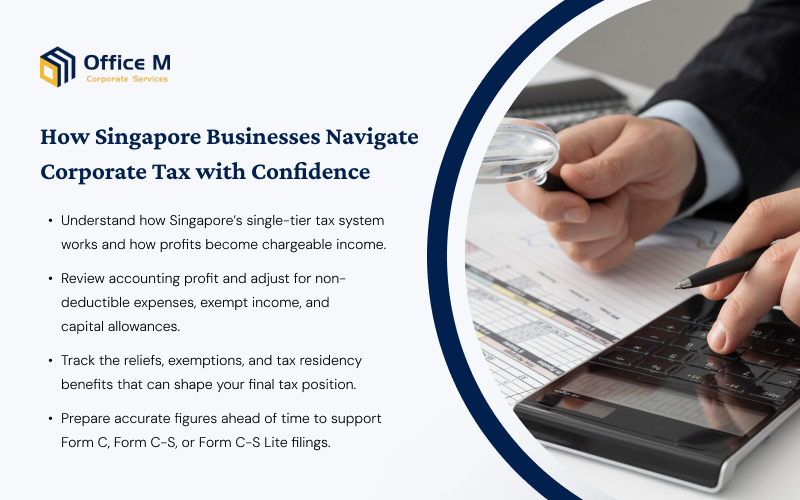
Understanding how corporate taxes are calculated in Singapore provides businesses with a clearer understanding of their financial responsibilities and helps them stay aligned with IRAS tax compliance requirements. The process combines the country’s tax rules, the structure of its single-tier corporate tax system, and the necessary adjustments to transition from accounting profit to chargeable income.

When each part is broken down, corporate tax computation becomes easier to approach. Companies are better equipped to make informed decisions, prepare accurate filings, and manage their overall tax position with greater confidence throughout the financial year.

Infographics on navigating Singapore Corporate Tax.

Key Features of Singapore’s Corporate Tax System

Singapore follows a single-tier corporate tax system, meaning profits are taxed only once. After a company pays tax on its earnings, any dividends distributed to shareholders are exempt from further taxation. This approach keeps the process straightforward and helps prevent double taxation of the same income, a common concern for many businesses new to corporate tax computation.

The prevailing corporate income tax rate is 17 percent, applied to chargeable income after all qualifying deductions, exemptions, and reliefs have been taken into account. Newer and smaller companies often benefit from start-up tax exemptions or partial exemptions, though these apply only after the company has accurately calculated its taxable income.

Tax residency is another crucial factor. Companies that qualify as Singapore tax residents can tap into a vast network of double tax agreements, gaining access to treaty benefits that reduce withholding taxes or minimise instances of double taxation on overseas income. This is particularly useful when filings are supported by a reputable corporate services company, ensuring that residency status and compliance records are appropriately maintained.

How Corporate Taxable Income Is Determined

Determining corporate taxable income starts with the company’s accounting profit, which is then adjusted to reflect what is taxable and what is not under Singapore’s tax rules. These adjustments sit at the heart of corporate tax computation, ensuring that the final figures align with IRAS requirements.

The adjustments typically involve adding back non-deductible expenses, removing non-taxable or exempt income, applying additional deductions where allowed, and claiming capital allowances on qualifying fixed assets. When handled carefully, these steps produce a final chargeable income figure that accurately reflects the company’s actual taxable position.

This process follows IRAS guidelines and is usually completed before filing Form C-S, Form C-S Lite, or Form C. Many companies prefer to outsource accounting services to professionals who can manage these calculations, maintain proper records, and help ensure accuracy throughout the filing process.

The Tax Filing and Computation Process

Once the figures are finalised, the corporate tax computation serves as the foundation for preparing the company’s annual income tax return. Depending on the company’s eligibility, the return may be filed using Form C, Form C-S, or Form C-S Lite.

Companies filing Form C must submit their tax computation, financial statements, and supporting schedules together with the return. Those eligible for Form C-S or Form C-S Lite enjoy a more streamlined process and do not need to submit supporting documents upfront. Even so, these records must still be properly prepared and kept on file, as IRAS may request them for verification at any point.

All companies must meet the annual filing deadline, typically on 30 November of the year following the end of their financial year. Staying on schedule helps avoid penalties and keeps compliance running smoothly. Well-organised records, from statements to schedules and past filings, make it easier to respond to queries and maintain a strong compliance history. With a clear and complete corporate tax computation, businesses can approach the filing process with greater confidence and fewer administrative surprises.

Infographic for smooth and accurate tax computation.

Applying Corporate Tax Computation in Practice

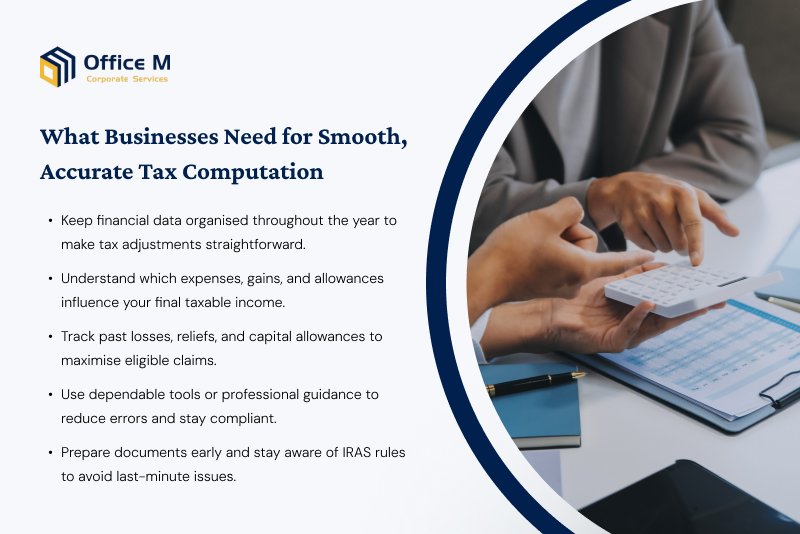
Applying tax rules in day-to-day business situations often requires more than understanding the concepts on paper. Companies need to review their financial records closely, identify the adjustments applicable to their specific circumstances, and maintain clear documentation to support every figure submitted to IRAS. In practice, corporate tax computation becomes a process of careful review, consistent tracking, and timely preparation rather than a once-a-year exercise.

Common Tax Adjustments and Areas Requiring Attention

Implementing tax rules often requires a closer examination of how various account items are treated for tax purposes. Differences between accounting standards and tax regulations can result in adjustments that impact your final numbers. These may include removing unrealised gains or replacing accounting depreciation with capital allowances. A careful review helps ensure that the final chargeable income aligns with IRAS requirements and reflects the principles of corporate tax computation in Singapore, rather than relying solely on accounting results.

Non-deductible expenses are another area that many businesses overlook. Fines, penalties, private expenses, and certain forms of entertainment must be deducted from accounting profit. Clear classification makes a meaningful difference and helps prevent issues such as underpayment or follow-up queries from IRAS.

Some expenses can work in your favour. Charitable donations, research and development spending, and other qualifying business expenses may be eligible for enhanced tax deductions and capital allowances, which can be easier to track when companies utilise structured accounting service packages. Making sure each item is categorised correctly helps support accurate claims.

It is also vital to track unutilised losses, past capital allowances, and reliefs from previous years. These may be carried forward or, in some situations, carried back, but only when the company meets IRAS conditions. Good documentation gives you the proof you need to support these claims.

For companies involved in overseas transactions or related-party dealings, proper transfer pricing documentation is crucial. IRAS expects businesses to follow the arm’s length principle and keep evidence that supports the pricing of such transactions. This level of documentation becomes a crucial aspect of maintaining accuracy in corporate tax computations in Singapore, particularly when cross-border activities are involved.

Best Practices for Accurate and Efficient Tax Computation

Accurate tax work becomes far more manageable when businesses adopt consistent, year-round habits rather than leaving everything to the last minute. Regular reviews of financial records help identify deductible and non-deductible expenses early, which reduces the amount of work needed at year-end and supports a smoother corporate tax computation process.

Technology can also make a meaningful difference. Accounting software with built-in tax reporting features helps streamline preparation, reduces manual errors, and keeps important information organised. When paired with reliable corporate tax filing services, businesses have an added layer of assurance that their submissions are complete and aligned with IRAS requirements.

Many companies also opt to collaborate with professional corporate service providers or tax consultants, particularly when navigating complex structures, managing overseas income, or filing multiple tax relief claims. Access to specialised guidance helps businesses navigate the finer details and reduces the likelihood of mistakes during filing.

Staying updated on Singapore’s annual Budget announcements is another helpful practice. Tax rules evolve over time, and keeping track of these changes ensures that businesses can benefit from new incentives or comply with updated regulations.

Preparing documentation well in advance of filing deadlines allows companies sufficient time to correct discrepancies, gather any missing information, and alleviate the stress often associated with last-minute submissions. This proactive approach supports clearer record-keeping and a more confident corporate tax computation every year.

A male executive reviewing a corporate tax report.

Questions You Might Have

1. How do I know if my company is required to file an ECI?

Most companies must file their Estimated Chargeable Income within three months of the financial year-end, unless they qualify for IRAS’s ECI filing waiver. Preparing your figures early provides a clearer view of your expected tax position and makes the corporate tax computation process significantly easier when it is time to file. It also helps you spot potential adjustments ahead of time, rather than rushing to resolve them at the last minute.

2. What happens if my company makes a loss during the year?

Even if a company incurs a loss, tax filing responsibilities still apply. These losses may be carried forward or, in some situations, carried back to offset taxable income from other years, provided the company meets the qualifying conditions. Clear records help ensure that your corporate tax computation accurately reflects these adjustments.

3. Are there penalties for errors in tax computation?

Yes. Errors, omissions, or incorrect declarations can lead to penalties, especially if they affect the accuracy of your submitted figures. IRAS also offers a Voluntary Disclosure Programme that allows companies to come forward and correct mistakes early. Using this pathway helps minimise potential penalties and demonstrates a clear intention to maintain good compliance practices.

4. Can corporate tax computation be outsourced?

Many businesses choose to outsource their computation and filing duties to professionals who provide taxation services in Singapore, especially when internal resources are limited or when operations involve multiple jurisdictions.

5. What is the difference between Form C, Form C-S, and Form C-S (Lite)?

Form C is the full corporate tax return and requires the submission of financial statements, a tax computation, and supporting schedules. Form C-S and Form C-S Lite are simplified versions for companies that meet specific criteria. Although supporting documents are not filed upfront for these forms, they must still be prepared and kept ready in case IRAS requests them.

A businessman reviewing tax computation charts on his desk.

Conclusion

Accurate corporate tax computation is an essential part of meeting your company’s statutory duties and managing tax liabilities with confidence. When businesses understand how adjustments work, keep their records organised, and prepare their figures carefully, they strengthen their compliance standing and reduce the risk of errors or late submissions. This also puts them in a stronger position to benefit from available exemptions, reliefs, and incentives within Singapore’s tax system.

Good preparation truly makes a difference. Companies that manage their timelines well, review their financial information consistently, and maintain proper documentation generally find the filing process far smoother when it comes time to submit their returns to IRAS. For businesses dealing with complex transactions or multiple revenue streams, having clear guidance can be especially helpful in supporting accurate corporate tax computation each year.

Office M works with companies that need clarity on tax rules, support with filing requirements, or help keeping their financial records in order. Professional guidance can alleviate the administrative burden and provide reassurance that compliance matters are being handled appropriately.

If you would like support with your corporate tax responsibilities, arrange a consultation with Office M to discuss your business needs and explore the compliance services available to you.

Corporate secretary consulting client on compliance using tablet.

Corporate Secretary Duties and Responsibilities: What Every Singapore Business Needs to Know

Introduction

The role of a corporate secretary in Singapore carries real legal weight. It is a statutory appointment under the Companies Act, and far from a simple administrative formality. This position anchors the company’s compliance framework and keeps the organisation aligned with regulatory expectations at every stage. Many businesses, especially SMEs, turn to a corporate services provider for guidance when they do not have in-house expertise to manage these requirements.

A corporate secretary acts as the bridge between directors, shareholders, and regulators. They help structure decision-making, maintain accurate documentation, and support the smooth execution of statutory obligations. Much of their work happens quietly in the background, yet it shapes how confidently a business can operate day to day.

The scope of corporate secretary duties and responsibilities goes well beyond preparing forms or filing documents. It includes advisory support on governance practices, preparation of key resolutions, coordination of statutory filings, and ensuring the company stays on track with its compliance commitments over time.

In many organisations, especially those without internal legal or compliance teams, the duties and responsibilities of a corporate secretary become a stabilising force. Their guidance helps safeguard the company’s long-term integrity, ensures accountability, and provides directors with clarity as the business grows or regulations evolve.

Singapore’s business landscape moves quickly, and companies of all sizes benefit from reliable secretarial support. Larger organisations value the structure it provides for governance, while SMEs rely on a corporate secretary to minimise compliance risks and maintain proper oversight. With consistent support in place, businesses can focus on growth while managing statutory expectations with confidence.

Key Takeaways:

  • A corporate secretary holds a statutory position in Singapore, helping the company meet its legal and regulatory obligations under the Companies Act.
  • Strong management of filings, records, and governance processes prevents penalties, supports transparency, and keeps daily operations running smoothly.
  • Directors and shareholders depend on the corporate secretary for accurate documentation, structured decision-making, and guidance on sound governance practices.
  • The duties and responsibilities of a corporate secretary provide long-term stability. Engaging capable support, whether in-house or through a service provider, strengthens compliance and supports sustainable business growth.

The Core Areas of Corporate Secretary Duties and Responsibilities

A corporate secretary manages the essential functions that keep a company compliant, organised, and well-governed. These areas cover regulatory filings, support for directors and shareholders, and the administrative work required to keep company records accurate and up to date. Together, the duties and responsibilities of a corporate secretary help the organisation meet statutory obligations, maintain clear communication among stakeholders, and operate confidently within Singapore’s regulatory environment.

Comparison table: In-House versus Outsourced Corporate Secretary.

Ensuring Legal and Regulatory Compliance

A key part of a corporate secretary’s duties and responsibilities is keeping the company aligned with Singapore’s regulatory framework. This includes preparing and submitting statutory filings, such as annual returns, written resolutions, and other ACRA filings, within the required deadlines. Companies that engage a company secretary service often benefit from consistent oversight that reduces errors, late submissions, and avoidable penalties.

Accurate maintenance of statutory registers, company records, and meeting minutes also forms a significant part of a corporate secretary’s duties and responsibilities. These documents create a clear and traceable record of the company’s activities and may be requested by ACRA or other authorities at any time. Well-maintained records ensure the business can respond quickly and confidently when information is required.

A corporate secretary also keeps track of upcoming compliance deadlines and monitors regulatory changes that may affect the business. This proactive approach helps directors stay informed and prevents issues such as missed filings or incomplete documentation. By staying up to date on evolving laws and reporting requirements, the company can adjust its internal processes and remain fully compliant as regulations shift over time.

Supporting the Board and Shareholders

Another aspect of a corporate secretary’s duties and responsibilities is facilitating clear communication between directors, shareholders, and regulatory bodies. This includes issuing meeting notices, preparing agendas, and ensuring important decisions are accurately recorded. For newly formed companies that engage incorporation services, this early support helps establish strong governance habits from the start.

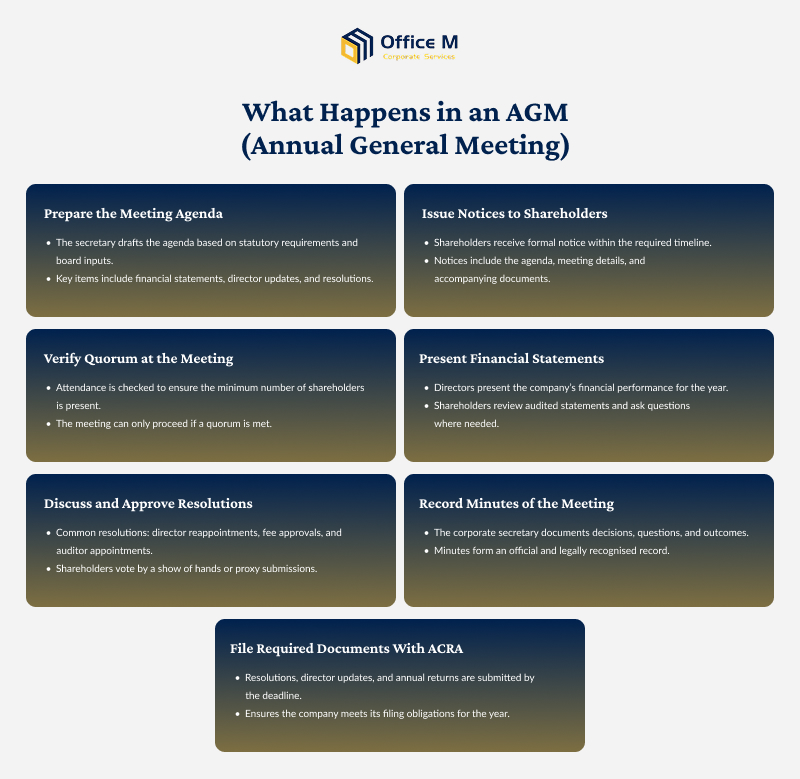
Much of a corporate secretary’s duties and responsibilities revolve around managing formal meetings. Planning and coordinating board meetings, extraordinary general meetings, and annual general meetings ensures that these sessions follow statutory timelines and procedural rules. The decisions made during these meetings must be appropriately documented for internal use and, where required, for filing with the authorities.

The corporate secretary also prepares and processes key resolutions involving share allotments, director appointments or removals, and amendments to the company constitution. These actions must meet legal standards, and directors often rely on the secretary’s governance expertise to ensure each step is carried out correctly. This structured support safeguards the integrity of board decision-making and helps maintain accountability as the company grows.

Corporate secretary writing notes during her administrative duties.

Administrative and Advisory Functions Beyond Compliance

Beyond formal compliance work, a corporate secretary manages a wide range of administrative duties that keep the company’s structure, records, and official information up to date. This includes issuing share certificates, maintaining the register of members, and ensuring that any changes to the company’s particulars are filed promptly with ACRA. These tasks are an integral part of a corporate secretary’s duties and responsibilities, helping the organisation maintain a clear and accurate record of its activities.

Corporate secretaries also provide practical advisory support. Their guidance helps directors address governance matters, including managing conflicts of interest, assigning responsibilities, and adopting internal policies that align with legal requirements. This blend of administrative and advisory work allows the board to navigate day-to-day decisions with confidence, drawing on the secretary’s understanding of regulatory expectations and good governance practices in Singapore.

Administrative oversight extends to structural updates such as changes in shareholding, amendments to the company constitution, or adjustments to the board. Each of these actions requires careful documentation and correctly submitted filings to ensure compliance. For smaller companies or those working from flexible setups, the secretary may also coordinate with services like virtual office rental to keep official records tidy and consistent across all touchpoints.

In many organisations, the duties and responsibilities of a corporate secretary form the backbone of ongoing processes. Their involvement ensures that administrative changes are documented accurately, that governance guidelines are followed, and that the company remains well-positioned to meet both regulatory expectations and internal needs as it grows.

Flowchart of a Corporate Secretary's Annual General Meeting duties.

Why These Duties Matter for Businesses

The work of a corporate secretary directly influences how smoothly a company operates. Their role goes beyond meeting statutory requirements. It supports clearer governance, stronger communication among stakeholders, and more confident long-term planning. By managing filings, maintaining accurate records, and guiding directors on proper procedures, the secretary helps the organisation minimise risks and stay aligned with Singapore’s regulatory expectations.

These functions become even more critical as the business expands, takes on new investors, or navigates more complex decisions. The duties and responsibilities of a corporate secretary provide the structure and assurance needed for a company to grow steadily without overlooking crucial compliance or governance steps.

Ensuring Smooth and Compliant Operations

Staying compliant with statutory requirements is essential for any business operating in Singapore. When a corporate secretary manages filings, maintains statutory registers, and keeps documents accurate, the company avoids issues such as late penalties, incomplete submissions, or discrepancies in official records. These tasks may seem administrative, but they form the foundation of dependable operations. A well-organised compliance framework also reduces internal friction, giving directors and managers access to current information instead of spending time resolving documentation gaps.

The duties and responsibilities of a corporate secretary are crucial to strengthening the company’s readiness during moments that require quick action. Whether the business is undergoing an audit, applying for financing, or responding to a regulatory inquiry, clear and complete records help the company act confidently and efficiently.

Over time, consistent compliance builds external trust. Investors, banks, and partners regularly conduct due diligence before committing to any business, and companies with well-maintained statutory records signal accountability and stability. These impressions can directly influence opportunities for funding, partnerships, and long-term growth. By fulfilling key corporate secretary duties and responsibilities, the secretary helps the organisation maintain a strong reputation and operate smoothly in Singapore’s regulatory landscape.

Supporting Strategic Growth and Governance

As a business grows, its governance needs become more layered and complex. A corporate secretary plays an essential role in helping the organisation establish structured, transparent decision-making processes. They ensure directors are aware of procedural rules, that resolutions are drafted with accuracy, and that key decisions are properly documented to meet both legal and governance standards. This reduces the risk of misunderstandings, disputes, or procedural errors as responsibilities expand.

The duties and responsibilities of a corporate secretary become even more significant during major corporate milestones, such as fundraising, mergers and acquisitions, restructuring, or the application for new licences. Stakeholders want assurance that decisions are made responsibly and that the company’s records clearly reflect these actions. For businesses with multiple shareholders or overseas investors, the secretary often serves as a neutral point of communication, ensuring that updates are shared accurately and in a timely manner.

By supporting directors with well-structured processes and reliable documentation, the corporate secretary helps reinforce strong governance practices. This contributes to the organisation’s credibility and creates a stable foundation for long-term growth. When the company begins to scale or explore new investment and partnership opportunities, the structure and oversight created through strong corporate secretary duties and responsibilities give stakeholders confidence in the organisation’s governance and decision-making.

Corporate secretary providing client support with a headset.

Questions You Might Have

1. Is it mandatory for every company in Singapore to appoint a corporate secretary?

Yes. Every company must appoint a corporate secretary within six months of incorporation, and the role cannot remain vacant beyond that point. The secretary must be a local resident who can perform key statutory functions, including handling filings, maintaining registers, and advising the company on compliance requirements. This ensures that the duties and responsibilities of a corporate secretary are fulfilled from the very beginning of the company’s operations.

2. Can a director also act as the corporate secretary?

A sole director cannot serve as both director and corporate secretary at the same time. In companies with more than one director, a director may take on the role if they have the necessary knowledge and experience. Still, many businesses choose to appoint a separate secretary to keep compliance tasks objective and prevent overloading the board.

3. What qualifications are required to act as a corporate secretary?

A corporate secretary must have enough expertise to manage statutory responsibilities confidently. For public companies, ACRA requires the secretary to be a registered filing agent or a qualified professional such as a lawyer, accountant, or someone with recognised corporate secretarial experience. Private companies have more flexibility, but the secretary must still understand company law, governance processes, and the practical corporate secretary duties and responsibilities expected in Singapore.

4. What is the difference between appointing an in-house corporate secretary and engaging a corporate service provider?

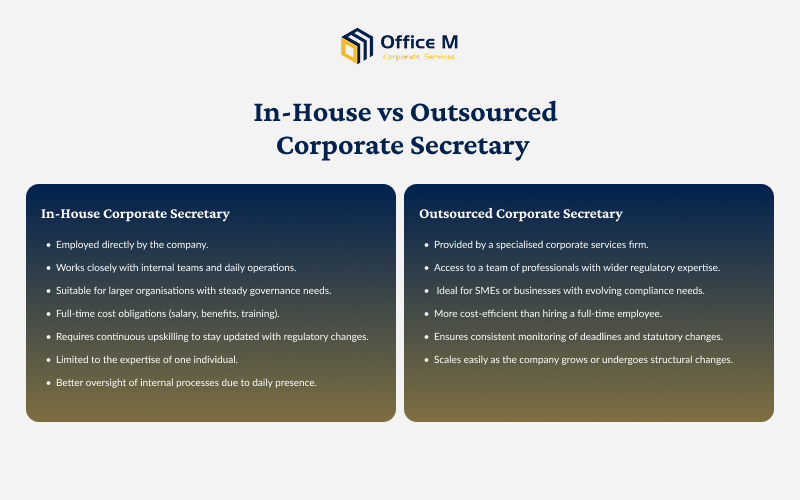
An in-house corporate secretary is employed directly by the company and focuses solely on internal governance and compliance needs. An outsourced corporate service provider offers access to a team of specialists who manage secretarial functions on the company’s behalf.

Many SMEs prefer outsourced support because it provides professional expertise, consistent compliance monitoring, and cost efficiency without the need for a full-time hire. This can be especially helpful for growing businesses with evolving governance and regulatory needs.

Corporate secretary preparing company documents and board meeting minutes.

Conclusion

A corporate secretary plays a central role in keeping a company compliant, organised, and well-governed. Beyond handling routine paperwork, they help ensure that statutory obligations are met, records remain accurate, and key decisions are documented in ways that satisfy regulatory standards. With this foundation in place, directors and shareholders can focus on running the business, knowing that core governance processes are being managed with care.

The duties and responsibilities of a corporate secretary become even more important as a business grows. Expansion often brings new structures, additional stakeholders, and more complex reporting needs. A capable secretary helps the organisation navigate these changes smoothly by reducing compliance risks, preparing proper documentation, and keeping the company aligned with Singapore’s regulatory expectations. For many SMEs, this steady support offers reassurance, especially when internal resources are limited.

When these corporate secretary duties and responsibilities are carried out consistently, the company benefits from more transparent governance, organised records, and a smoother compliance journey as it grows.

Office M provides corporate secretarial, compliance, and governance services tailored to the needs of Singapore businesses at different stages of growth. Our team helps companies meet statutory requirements, maintain clear records, and build governance practices that strengthen over time.

If you are looking to enhance your compliance framework or streamline governance processes, reach out to Office M to learn how our services can help your company advance with confidence.

Office M consultants discussing business registration strategy.

A Comprehensive Guide for Foreigners Looking to Register a Company in Singapore

Introduction

Singapore has earned its place as one of the world’s most trusted destinations for business and investment. With a stable political climate, transparent regulations, and a pro-business environment, it continues to attract entrepreneurs and global companies seeking a gateway to Asia. Its strong legal system, advanced infrastructure, and ease of doing business make it a preferred choice for international expansion.

Foreign investors are particularly drawn to Singapore for its favourable tax framework, wide network of trade agreements, and efficient company incorporation process. The city-state’s focus on governance, innovation, and global connectivity reinforces its reputation as a secure and dynamic base for growth.

Under Singapore law, anyone conducting business activities for profit on an ongoing basis must register an entity with the Accounting and Corporate Regulatory Authority (ACRA). This ensures compliance with statutory obligations and gives businesses the legal standing to operate within the country.

This guide explains how foreigners start a business in Singapore and outlines the process to register a company in Singapore for foreigners, from choosing the right business structure to meeting local residency requirements and filing through BizFile+. With the right preparation and professional guidance, establishing a business in Singapore can be a smooth and rewarding process.

Key Takeaways:

  • Foreign investors can establish and fully own a Singapore company, provided they meet local residency and representation requirements set by ACRA.
  • Selecting the right entity type, such as a private limited company or branch office, determines liability, compliance scope, and long-term scalability.
  • Partnering with a qualified corporate service provider helps streamline incorporation, ensure accurate filings, and maintain governance standards.
  • Singapore’s transparent regulations, favourable tax framework, and strategic location continue to attract global entrepreneurs seeking a stable base for regional growth.

Establishing a Business Presence in Singapore

Setting up a business in Singapore is a clear and structured process designed to support transparency and investor confidence. To register a company in Singapore as a foreigner, it is important to understand how ownership rules, residency conditions, and statutory requirements set by ACRA work together to ensure compliance.

Singapore allows full foreign ownership while requiring local representation to meet regulatory obligations. With proper planning and professional support, foreign entrepreneurs can establish a credible and compliant business presence built for long-term success in the region.

The Business Landscape for Foreign-Owned Companies

Singapore provides one of the most open and supportive environments for international investors. Foreigners are allowed to own 100% of a Singapore-registered business entity, giving them full authority over corporate decisions, shareholding structures, and management operations. This flexibility enables entrepreneurs to operate independently without local shareholder involvement.

However, each company must appoint at least one locally resident individual in a key management or representative role. This ensures there is an authorised point of contact within Singapore for regulatory communication and compliance purposes. A locally resident person may be a Singapore Citizen, Permanent Resident, or a valid Employment Pass or EntrePass holder.

Foreign Identification Number (FIN) holders should confirm their eligibility with the relevant authority, such as the Ministry of Manpower (MOM) or the Immigration and Checkpoints Authority (ICA), before accepting an appointment. This step ensures compliance with ACRA’s statutory requirements for company officers.

Many foreign investors choose Singapore as their regional base due to its extensive trade agreements, robust legal protections, and strong financial infrastructure. The country’s transparent legal system, efficient dispute resolution mechanisms, and reliable banking network further enhance its reputation as a trusted destination for Singapore business registration for overseas investors.

For entrepreneurs planning long-term expansion across Asia, understanding the foreign business setup requirements is an essential first step before proceeding to register a company in Singapore as a foreigner.

Infographic on choosing the right business entity type.

Choosing the Right Type of Business Entity

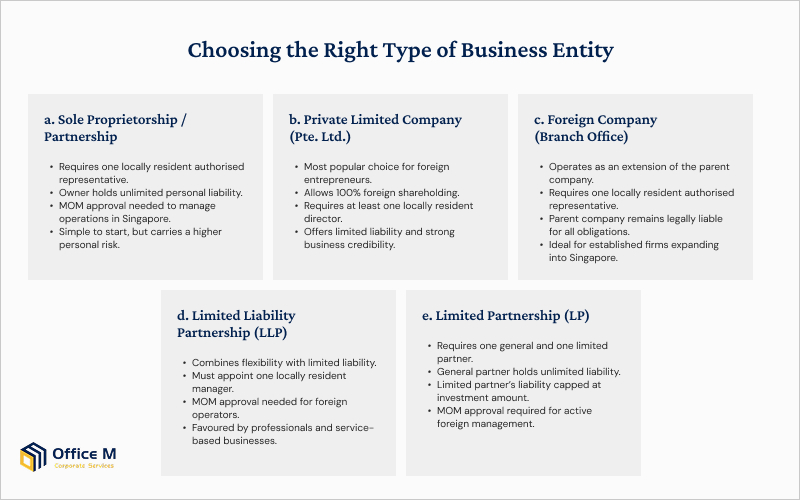
The type of entity you choose when you register a company in Singapore as a foreigner will determine your business’s legal liability, compliance obligations, and eligibility for government schemes or tax incentives. As long as residency and statutory requirements are met, foreigners may incorporate any of the following entities through ACRA.

A. Sole Proprietorship or Partnership

Foreigners may set up a sole proprietorship or partnership in Singapore, but at least one locally resident authorised representative must be appointed. This individual assumes full personal liability for the business and acts as the main point of contact for regulatory purposes.

Foreign entrepreneurs residing overseas who wish to manage their business directly in Singapore must first obtain approval from the Ministry of Manpower (MOM). Although this structure is straightforward and affordable, it carries higher personal risk because liability is not separated from the owner. For this reason, it is less commonly chosen by those looking to register a company in Singapore as a foreigner.

B. Local Company (Private Limited Company)

The Private Limited Company remains the most preferred structure for investors planning to register a company in Singapore as foreigners. It allows 100% foreign shareholding and requires at least one locally resident director to meet ACRA’s statutory requirement.

This model offers limited liability protection, ensuring that shareholders’ personal assets are not affected by company debts or obligations. It also enhances business credibility when dealing with clients, financial institutions, and investors. For entrepreneurs seeking scalability, stability, and compliance assurance, the private limited company structure offers the most suitable foundation for growth.

C. Foreign Company (Branch Office)

An overseas corporation can register a company in Singapore as a foreigner by establishing a branch office. This option allows the foreign company to extend its operations to Singapore while remaining legally part of its parent entity. At least one locally resident authorised representative must be appointed to oversee compliance.

While a branch office can carry out the same business activities as its parent company, it does not enjoy separate legal status. This means the parent company remains liable for all obligations incurred in Singapore. Branch offices are typically chosen by established businesses expanding into the market without forming a new incorporated entity.

D. Limited Liability Partnership (LLP)

An LLP combines the flexibility of a partnership with the protection of limited liability. It must appoint at least one locally resident manager who is responsible for ensuring compliance with Singapore’s laws and annual filing requirements.

Foreign entrepreneurs based overseas must designate a local manager, while those intending to operate within Singapore need MOM approval before commencing operations. Many consultants, designers, and professional service providers opt for this structure when they register a company in Singapore as foreigners because it allows shared management while limiting personal exposure to risk.

E. Limited Partnership (LP)

A Limited Partnership consists of at least one general partner and one limited partner. The general partner must be locally resident and holds unlimited liability, whereas the limited partner’s liability is confined to their investment amount.

Foreigners wishing to actively manage an LP within Singapore must obtain approval from MOM before taking up the role. As with other structures, the appointed local partner or manager bears responsibility for ensuring that the partnership complies with ACRA’s regulations.

Each entity type presents unique advantages based on your business goals, level of control, and appetite for risk. For investors assessing how foreigners start a business in Singapore, understanding these structures ensures a well-informed decision before proceeding to register their company.

Foreign entrepreneurs discussing Singapore company registration.

Incorporation and Application Process

The process to register a company in Singapore as a foreigner is completed through BizFile+, the Accounting and Corporate Regulatory Authority’s (ACRA) online filing portal. While the overall procedure is straightforward, the exact steps may vary depending on the applicant’s residency status, visa type, and eligibility to access the system.

For Foreigners with an EntrePass

Foreign entrepreneurs holding an EntrePass can apply directly through BizFile+ using their SingPass credentials. During the application, they must submit:

  • A proposed company name for ACRA’s approval.
  • Details of all shareholders, directors, and company officers.
  • The company constitution and supporting identification documents.

Once the application is approved, ACRA issues a Unique Entity Number (UEN) to confirm successful incorporation. This streamlined process allows EntrePass holders to manage their registration independently without engaging local intermediaries.

For Foreigners without an EntrePass

Foreigners who do not hold an EntrePass must engage a corporate advisory firm in Singapore, such as a law firm, accounting practice, or professional corporate secretarial agency, to file the application on their behalf. These authorised agents assist with name reservation, document preparation, and the submission of incorporation details in compliance with ACRA regulations.

This arrangement is necessary to register a company in Singapore as a foreigner, as BizFile+ access is restricted to users with valid SingPass credentials, which non-residents typically do not possess.

Supporting Steps Before and After Incorporation

  • Company name approval: The proposed company name must be approved by ACRA before incorporation. It should be unique, appropriate, and free from conflicts with existing registered entities or trademarks.
  • Document preparation: Key documents include the company constitution, Know Your Customer (KYC) verifications for all shareholders and directors, and signed consent-to-act forms. These ensure transparency and compliance with regulatory standards.
  • Appointment of a local representative: At least one locally resident director or authorised representative must be appointed before the company can be registered. This individual acts as the official point of contact for statutory matters.
  • Online filing: Incorporation details are submitted via BizFile+, ACRA’s online system. Most applications are processed within one to three working days, provided all documentation is in order.
  • Opening a corporate bank account: After incorporation, a corporate bank account should be opened with a licensed financial institution in Singapore. Some banks may require directors or signatories to be present for identity verification and due diligence checks.

Additional Administrative Considerations

Professional firms providing company incorporation services often offer ongoing administrative and compliance support to help businesses stay organised after registration. These services may include:

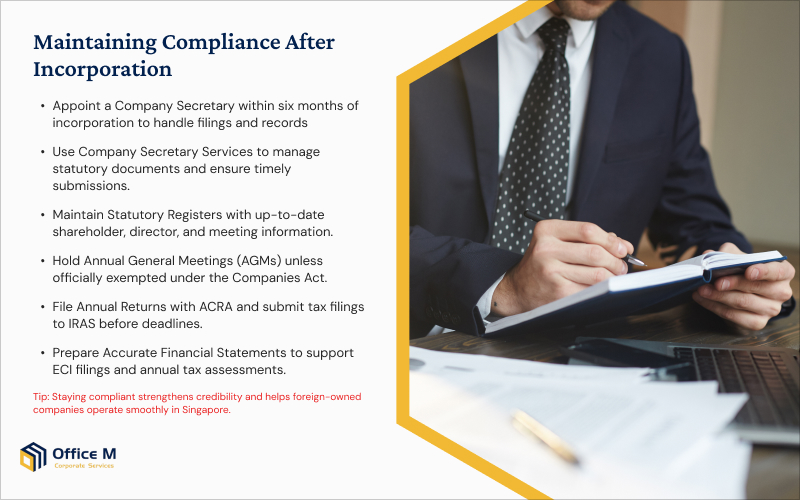
  • Appointment of a qualified company secretary to meet statutory requirements.
  • Maintenance of statutory registers, meeting minutes, and corporate records.
  • Preparation and filing of annual returns and other documents with ACRA.

Foreign applicants should engage an experienced agent familiar with BizFile company registration for foreigners to ensure that all documents are correctly prepared and filed. Fees typically vary depending on the complexity of the application and any additional services required, such as appointing a nominee director or arranging an office address rental in Singapore for official correspondence.

Partnering with a trusted corporate advisory firm allows entrepreneurs to register a company in Singapore as a foreigner while meeting all foreign business setup requirements and maintaining a credible, compliant business presence.

Infographic on maintaining compliance after incorporation.

Compliance and Ongoing Obligations

Once you register a company in Singapore as a foreigner, your responsibilities extend beyond incorporation. Every Singapore-registered company must meet ongoing statutory requirements, such as appointing key officers, maintaining accurate records, and submitting annual returns and tax filings on time.

Understanding and fulfilling these obligations helps foreign business owners maintain compliance, demonstrate sound governance, and uphold credibility with ACRA, IRAS, and other regulatory authorities.

Maintaining Compliance After Incorporation

After you register a company in Singapore as a foreigner, ongoing compliance is vital to keeping your business in good legal standing and avoiding penalties. All companies must meet statutory obligations outlined by the Accounting and Corporate Regulatory Authority (ACRA) and the Inland Revenue Authority of Singapore (IRAS). These include:

  • Appointment of a company secretary within six months of incorporation. Many foreign entrepreneurs engage professional company secretary services to ensure proper record-keeping and timely submissions.
  • Maintenance of statutory registers and company records, covering shareholder, director, and meeting information.
  • Holding of Annual General Meetings (AGMs) unless exempted under the Companies Act.
  • Submission of annual returns to ACRA and corporate tax filings to IRAS within the prescribed deadlines.
  • Preparation of accurate financial statements to support Estimated Chargeable Income (ECI) submissions and tax assessments.

Adhering to these requirements demonstrates strong corporate governance and enhances trust with regulators, financial institutions, and business partners. Engaging a professional corporate advisory firm helps ensure all documentation and filings are managed efficiently, allowing you to focus on business growth with confidence.

Relocation, Passes, and Local Management

Foreign entrepreneurs who wish to relocate to Singapore and manage their operations directly can apply for an Employment Pass or EntrePass, depending on their business model and investment scale. The EntrePass may be submitted either before incorporation or within six months after registration. Each application is reviewed by the Ministry of Manpower (MOM) based on business viability, applicant experience, and potential contribution to Singapore’s economy. This flexibility makes it easier for foreigners to establish and register a company in Singapore with long-term operational control.

For those already residing in Singapore, Dependants’ Pass holders may apply for a Letter of Consent (LOC) to run a business after incorporation with ACRA. Individuals holding a Foreign Identification Number (FIN) should confirm eligibility with MOM before accepting roles such as director, secretary, or manager.

Entrepreneurs who prefer to manage their company from abroad can continue doing so, provided at least one locally resident director or authorised representative remains appointed to ensure compliance. Many business owners engage professional firms that offer nominee director services to fulfil this statutory requirement reliably and transparently. This arrangement allows foreigners to register a company in Singapore while maintaining proper local representation and regulatory accountability.

Office M consultants assisting a client with business setup.

Questions You Might Have

Is 100% foreign ownership allowed?

Yes. Foreigners can own 100% of a Singapore-incorporated business without the need for local shareholders. This gives full control over business decisions, profit distribution, and shareholding structure. However, to register a company in Singapore as a foreigner, at least one locally resident director or authorised representative must still be appointed to satisfy ACRA’s statutory requirements.

Do I need to be in Singapore to incorporate a company?

No. You do not need to be physically present in the country to register a company in Singapore as a foreigner. The entire incorporation process can be completed remotely through a registered agent or corporate advisory firm. Most steps, including company name reservation and constitution submission, are carried out online via ACRA’s BizFile+ system. However, some banks may require directors or authorised signatories to attend an in-person verification meeting before opening a corporate bank account.

What is the minimum capital required?

The minimum paid-up capital for incorporation in Singapore is S$1, which makes it accessible for startups and small enterprises. There are no restrictions on the currency used or when capital can be increased. Many businesses raise their paid-up capital after incorporation to enhance credibility, meet visa eligibility criteria, or qualify for specific licences and government grants.

Can a dependant’s pass holder run a business?

Yes. Dependants’ Pass holders may operate a registered business after obtaining a Letter of Consent (LOC) from the Ministry of Manpower (MOM). The LOC allows them to take part in daily operations or management of their company. Those who prefer not to relocate can continue managing operations remotely, provided a locally resident manager or director is appointed to oversee compliance matters.

What support is available for foreigners after incorporation?

Foreign entrepreneurs can access professional assistance from corporate service firms that handle ongoing compliance and administrative responsibilities. These specialists manage statutory filings, maintain company records, and ensure timely submissions to local authorities. Engaging such support allows business owners to maintain compliance and focus on growth, making it easier to register a company in Singapore as a foreigner and operate sustainably in the long term.

Busy office environment with corporate services support.

Conclusion

The process to register a company in Singapore for foreigners is straightforward and supported by a business environment built on transparency, efficiency, and trust. While the incorporation framework is designed to be accessible, understanding local residency requirements, company structure options, and ongoing compliance duties is essential to operating confidently and legally.

Foreigners can fully own a Singapore-registered company but must appoint at least one locally resident director, manager, or authorised representative, depending on the entity type. All applications are filed through ACRA’s BizFile+ platform. For those without an EntrePass, engaging an experienced corporate advisory firm ensures that every step of the process is completed accurately and in compliance with statutory timelines.

With its stable governance, pro-business tax system, and strategic connectivity, Singapore remains a leading choice for entrepreneurs worldwide seeking to register a company in Singapore as foreigners and build a long-term presence in Asia.

Office M supports foreign business owners through every stage of incorporation, offering structured guidance in compliance, nominee directorship, and corporate governance. Contact Office M today to begin your incorporation journey with confidence and establish a trusted foundation for your business in Singapore.


Diverse professional team at a small company in Singapore collaborating during an office meeting

Do You Qualify as a ‘Small Company’ in Singapore? What It Means for Compliance

Key Takeaways:

  • The “small company” classification determines a business’s eligibility for audit exemption and defines its annual filing obligations with ACRA.
  • To qualify, a company must meet at least two out of three financial thresholds relating to revenue, assets, and employee count.
  • Eligibility must be maintained over two consecutive financial years, and group entities must meet the “small group” criteria to remain qualified.
  • Even with lighter reporting requirements, businesses must still file annual returns, maintain proper records, and ensure continued compliance with ACRA regulations.

Introduction

Starting or managing a small company in Singapore comes with many benefits, but it also carries specific responsibilities under the Companies Act. The term “small company” does more than decide if your business qualifies for an audit exemption; it also shapes your ongoing obligations with the Accounting and Corporate Regulatory Authority (ACRA).

By understanding how this classification works, you can plan ahead, meet your legal requirements on time, and avoid unnecessary compliance issues. Here’s what you need to know about how eligibility is determined, why it matters, and how professional support can help your business stay compliant with ease.

How Is a Small Company Defined in Singapore?

In Singapore, a small company is a private entity that meets at least two out of three key conditions over the past two financial years:

  • An annual revenue of S$10 million or less
  • Total assets of S$10 million or less
  • No more than 50 employees

These benchmarks enable smaller businesses to benefit from simplified reporting while maintaining accountability and transparency. Once a company exceeds these limits, it will no longer qualify for the same reduced compliance requirements.

Why Must Eligibility Be Maintained Over Two Financial Years?

A company’s classification as a small company must remain consistent across two consecutive financial years. This requirement prevents the status from changing too easily due to short-term variations in performance or staffing levels.

Maintaining eligibility over time allows ACRA to assess compliance more fairly and accurately. Regular reviews of your company’s financial statements and workforce numbers can help confirm that you continue to meet the required thresholds. Professional incorporation service providers can also provide valuable guidance to ensure your records and filings stay aligned with regulatory expectations.

What If the Company Belongs to a Group?

If your company is part of a larger corporate group, both the individual entity and the group as a whole must meet the “small group” criteria to qualify.

ACRA determines this status using consolidated figures that include all subsidiaries under the group. The total combined revenue, assets, and employee count must stay within the small company thresholds. This approach ensures that only genuinely smaller businesses benefit from simplified compliance, rather than larger groups operating under multiple entities.

Do Small Companies Still Need to File Annual Returns?

Even if a small company in Singapore qualifies for an audit exemption, it must still meet all statutory filing obligations.

Every private limited company is required to prepare and file its financial statements, keep its ACRA records updated, and complete its annual return filing. These submissions confirm that the business remains active and compliant with ACRA compliance requirements. Missing deadlines or submitting inaccurate information can result in penalties and negatively impact the company’s standing with the relevant authority.

How Can a Company Secretary Help Maintain Compliance?

Professional company secretary services in Singapore are essential for helping your business stay compliant throughout the year. The company secretary monitors your classification status, prepares board resolutions, and ensures all required documents are filed with ACRA accurately and on schedule.

This ongoing support minimises the risk of missed deadlines and promotes strong corporate governance. It also gives directors confidence that their company continues to meet the conditions for audit exemption and fulfils all obligations expected of a private limited company.

Why Work With a Corporate Services Provider?

Engaging a trusted corporate services provider in Singapore can simplify the management of compliance and help you stay up-to-date with regulatory changes. Professional teams assist with record-keeping, preparing financial statements, and managing annual filing timelines, ensuring your company consistently meets statutory obligations.

From incorporation to ongoing compliance monitoring, the right provider ensures your business operates efficiently, maintains transparency, and stays aligned with ACRA’s regulatory standards.

Business executives at a small company in Singapore reviewing financial reports and documents during a private consultation in the office.

Conclusion

Qualifying as a small company in Singapore provides valuable benefits for SMEs, including greater flexibility and reduced reporting requirements. However, maintaining this status calls for consistent attention to record-keeping, classification criteria, and filing deadlines.

For dependable support in company formation, compliance management, and ongoing ACRA obligations, contact Office M. Our experienced team ensures your business remains compliant, organised, and well-positioned for sustainable growth.